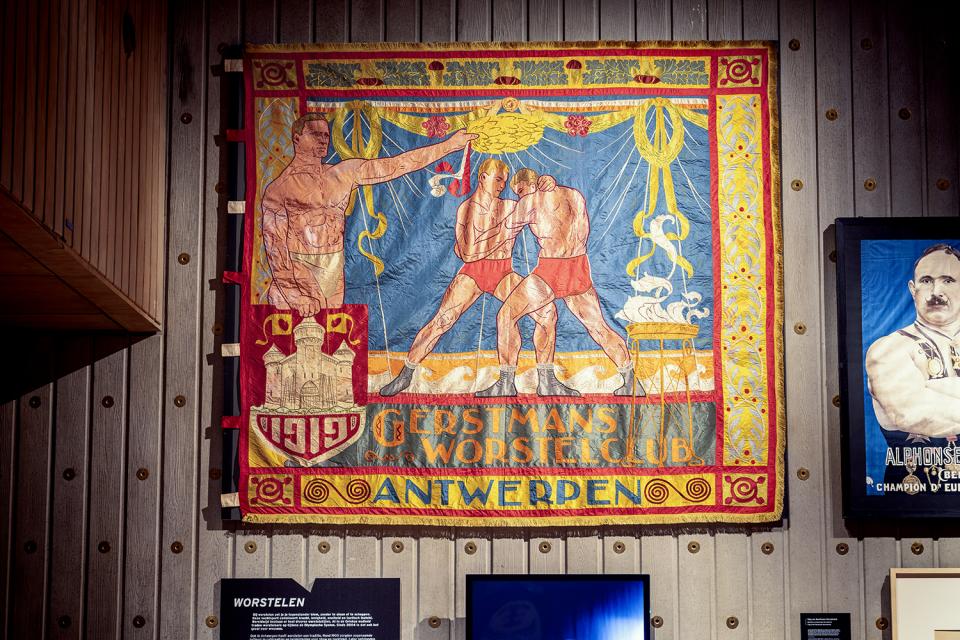
Flag of Gerstmans wrestling club
Antwerp, Belgium, 1919
Silk
MAS, HH.3228
In 1919, Gerstmans left the amateur club behind and founded his own Gerstmans Wrestling Club. His goal quickly became to train professional wrestlers. In doing so, he laid the foundation for professional show wrestling in Belgium, also known as “catch.”
To promote his new club, he designed a giant flag. The figure on the left resembles Gerstmans himself. He holds a laurel wreath above two young fighters: the trainer passing the torch to the next generation of wrestlers. After his athletic career, Gerstmans opened Café Jozef at Astridplein, where wrestling also took place.
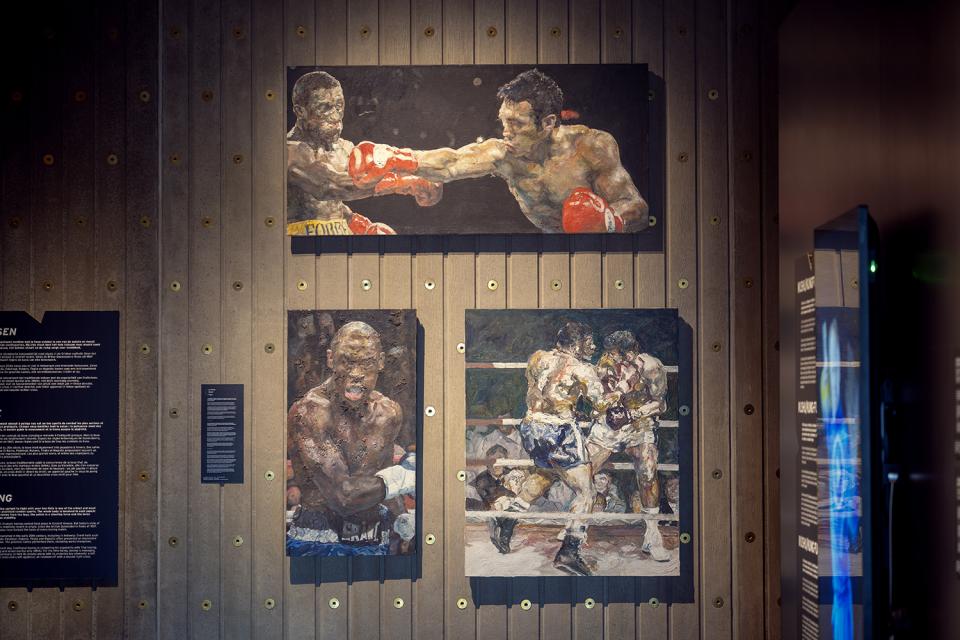
Le Poète, 2006
Boxer, 2006
Fight, 2008
Sam Dillemans, Antwerp, Belgium
Oil on canvas
On loan from the artist
For painter Sam Dillemans (b. 1965, Leuven), boxing is a technical challenge. He previously drew countless powerful body parts inspired by Old Masters such as Tintoretto and Rubens. To paint bodies in motion, he focused on boxers.
The three paintings in the exhibition show the three stages of his development. Initially, he painted as he remembered boxing scenes. This is evident in Le Poète, where a firm right punch is delivered. The trained bodies of the boxers are realistic, not idealized. Dillemans captures both the brutality and nobility of boxing.
Later, he applied thicker layers of paint. The boxer in Boxer is injured and vulnerable but remains determined; the figure is still recognizable. In a third phase, the image becomes more abstract. Raised brushstrokes and unpainted areas emphasize the dynamics of boxing. In Fight, the bodies of the boxers are barely recognizable.
Dillemans is originally from Leuven but has had his studio and exhibition space in Antwerp North since 2016.
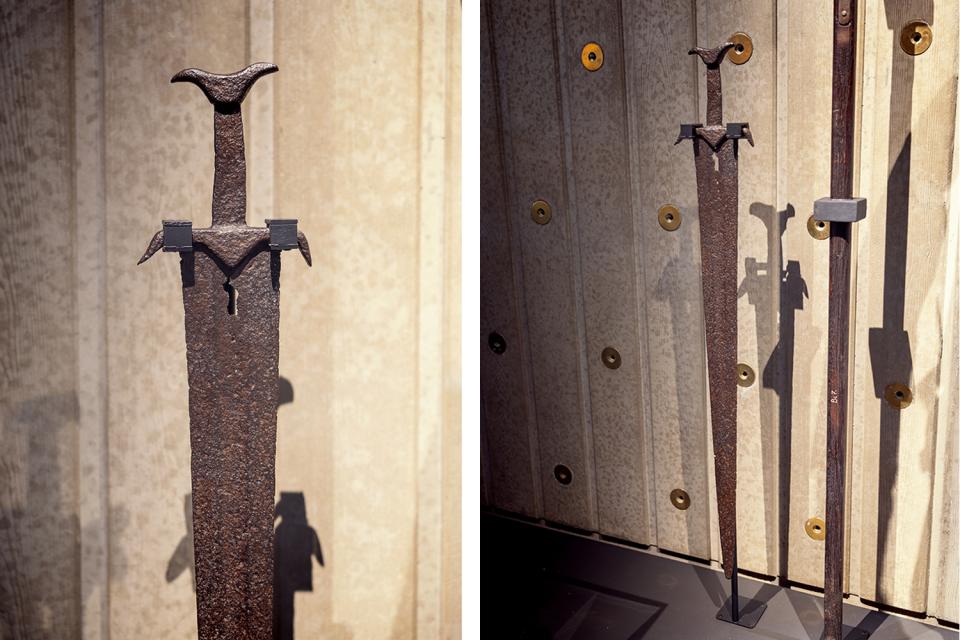
Sword, Oakeshott type XIV
MAS, AV.8448
Recovered from the Scheldt River. Other provenance unknown. Acquired in 1900
In the exhibition, the weapon appears in the subtheme “Knights and Samurai,” focusing on sports with roots in a long-standing martial culture.
Its exact origin is unknown, but this type was common in Europe between 1270 and 1340. Practitioners of Historical European Martial Arts (HEMA) mainly base their weapons on historical fighting manuals from later periods. As a result, this type of sword is rarely seen among HEMA practitioners. In the exhibition, you can view it up close.
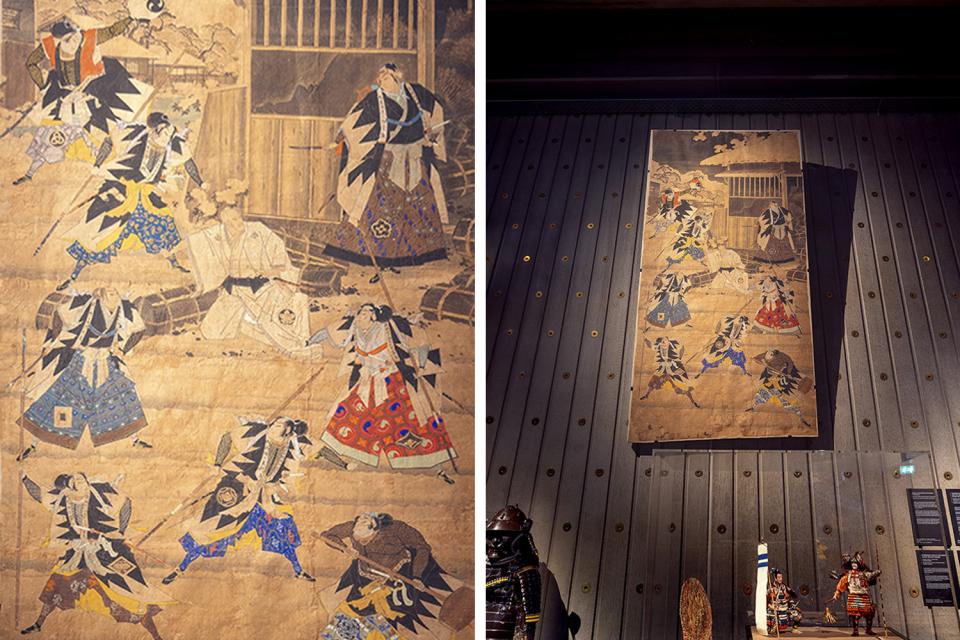
Kabuki Theater Poster: Kanadehon chūshingura
Japan, late 19th century
Inkt and pigment on paper
MAS, AE.4710
Bequest of Jules Baetes, 1938
Kanadehon chūshingura a (“The Treasury of Loyal Retainers”) is a romanticized stage version of a well-known true story from 18th-century Japan. It recounts the tale of 47 rōnin, masterless samurai.
After their lord is killed, the 47 warriors deliberately divert attention away from themselves. Only when their arch-enemy no longer expects it do they seek revenge. Ultimately, they gather at the estate of the perpetrator and kill the man responsible for their lord’s death.
The 47 rōnin became a national symbol in Japan of loyalty, perseverance, self-sacrifice, and honor. On the poster, they are shown surrounding their opponent, ready for battle. This piece originally hung on the facade of a theater in Japan before making its way to Antwerp. It connects martial arts to the samurai code of honor, bushidō.
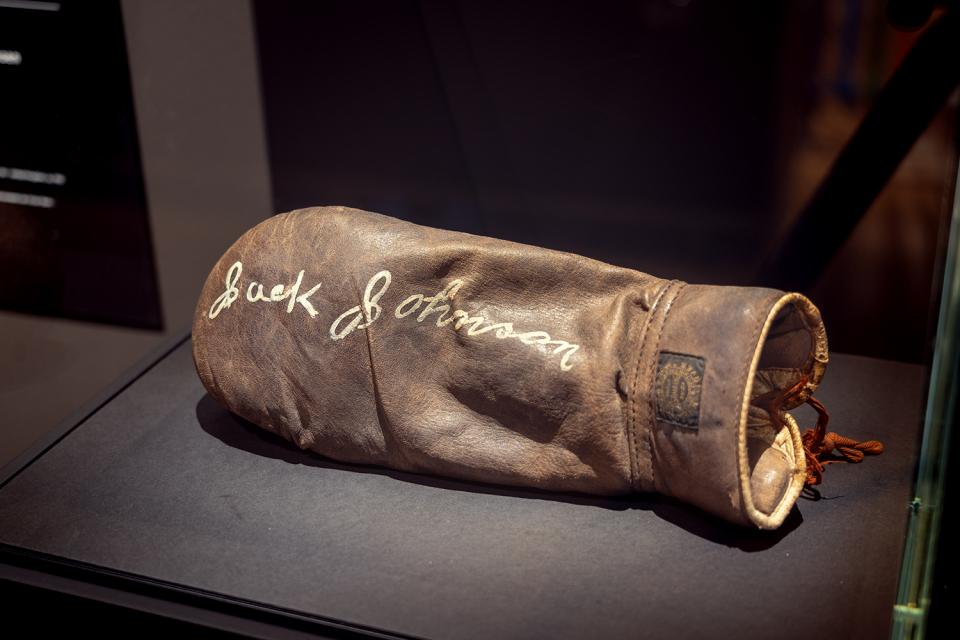
Jack Johnson's boxing glove
G.A. Spalding & Bros., United Kingdom, c. 1913
Leather
Sportimonium, Cabinet Victor Boin, SMVD007179
Donation from the heirs of Victor Boin
One of the greatest boxers of all time was the American Jack Johnson (1878–1946). In 1908, he became the first Black world heavyweight champion.
This did not sit well with white American boxing promoters. They frantically sought a “Great White Hope” to defeat the black champion. Johnson’s victory over white boxer Jim Jeffries in 1910 led to race riots in cities including Chicago, New York, and Atlanta.
Johnson enjoyed partying and had relationships with several white women—taboo at the time in racially segregated United States. For many black Americans, he was therefore a hero who defied segregation. In 1912, Johnson was arrested under the Mann Act for crossing state lines with a white woman.
He fled to Europe. In 1913, he visited Antwerp, where he fought, among others, a demonstration match against Belgian champion Georges Grundhoven at the Thalia hall on Carnotstraat. During his stay in Belgium, he gave a signed boxing glove to sports journalist and athlete Victor Boin. That glove is on display in the exhibition, alongside an enlarged black-and-white photograph taken just before the match.
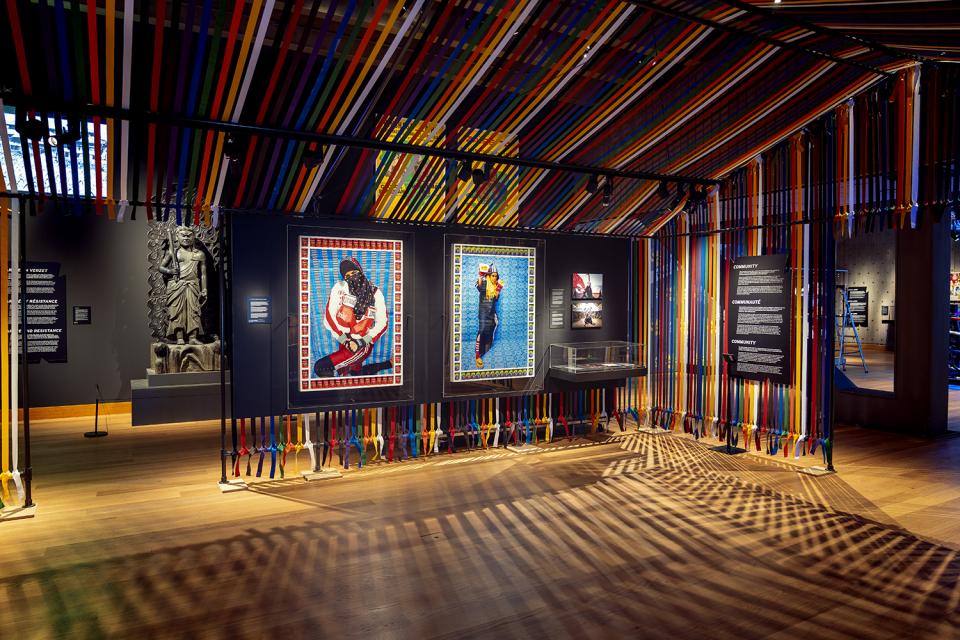
La Salle de Gym des Femmes Arabes
Hassan Hajjaj
Morocco and United Kingdom, 2011-2016
C-print with metal frame
Gallery The Third Line
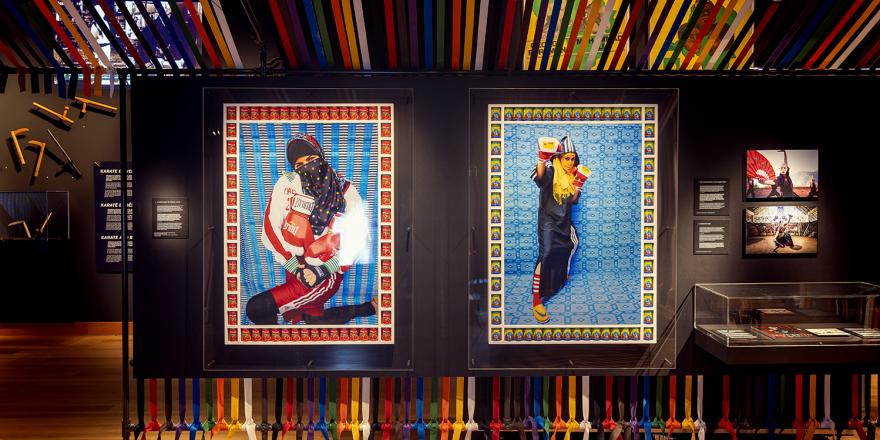
In ‘La Salle de Gym des Femmes Arabes’ (“The Gym of Arab Women”), Moroccan-British artist and photographer Hassan Hajjaj (b. 1961, Larache, Morocco) places women at the center.
In doing so, he challenges stereotypical representations of gym culture and martial arts, which are often seen as male-dominated. Because he does not have access to women’s gyms as a man, he constructs this world through his imagination, using carefully staged imagery.
The exhibition features two photographs from the series. They highlight the strength and elegance of the athletes, dressed in designer niqabs and striking footwear. By combining elements of traditional clothing with recognizable sports and designer logos, Hajjaj breaks stereotypes. His images emphasize the women’s confidence and individuality.