

Between October 13, 1944, and the end of March 1945, the German army fired more than 6,000 V1 and V2 bombs at Antwerp from Germany and the Netherlands. The Allies responded with Antwerp X, a special mission led by American Brigadier General Clare H. Armstrong. Antwerp X was very successful against the V1 bombs, but less so against the faster V2s.
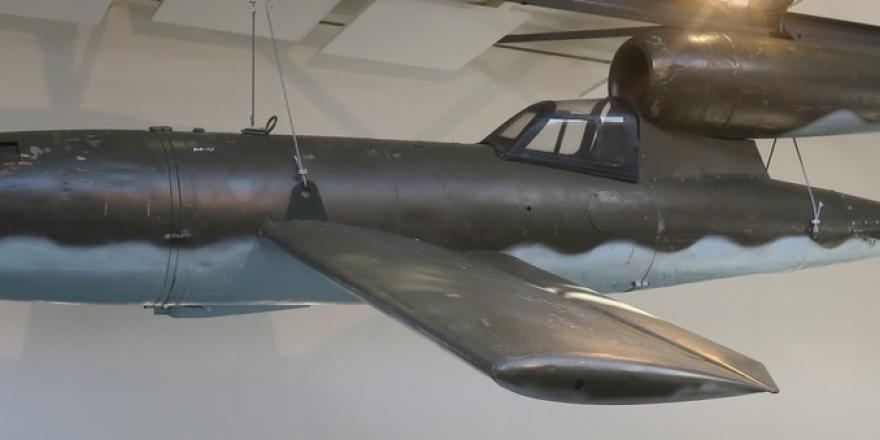
On June 12, 1945, American Brigadier General Clare H. Armstrong donated two V-bombs to Antwerp as a reminder of the bitter struggle: an intact V1 practice bomb and a slightly damaged manned flying bomb. The intact bomb (AV.1945.013) is on display at the MAS exhibition ‘City at War. The manned bomb, the ReIV, we loaned to the Musée La Coupole near Saint-Omer in northern France. The loan agreement with Musée La Coupole was renewed at the end of 2025.
Musée La Coupole
La Coupole is located in the enormous bunker built in 1943 by forced laborers from Organisation Todt. The bunker was used to store V2 bombs that were to be launched towards London. The Allied landings in Normandy on June 6, 1944, and the bombing by the Allied armies prevented the launch base from being used.
The museum presents a broad overview of the military history of World War II, with a special focus on the technology of V-bombs. Various types of V-bombs are on display in the exhibition. Photographs illustrate how Antwerp was severely affected by V-bombs.
The site also houses a planetarium about space travel. The rocket technology of the V2 bomb was a source of inspiration for later American space travel.
Unique: a controllable V1
The Re IV flying bomb was a V1 bomb, but with a seat and control system for a pilot. The pilot had to escape with a parachute just before the bomb exploded. The German army designed this type of bomb, but never used it. Only a few bombs of this type have been preserved. For military history, the ReIV from the MAS collection is therefore a unique and rare specimen, although several parts, including the cockpit and part of the wings, are no longer authentic. After the war, the bomb was partially repainted in olive green.
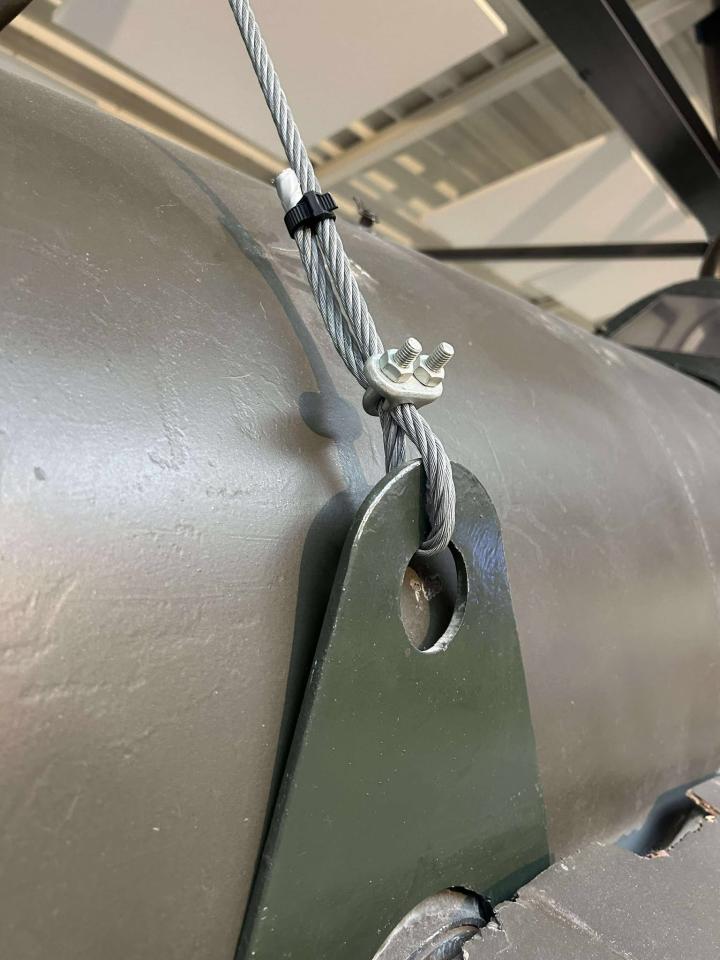
Museum La Coupole and the MAS agreed to improve the hanging system so that friction would no longer have an impact on the bomb.
Image above: the manned flying bomb with code name Reichenberg (Re) IV (MAS, AV.1945.014)