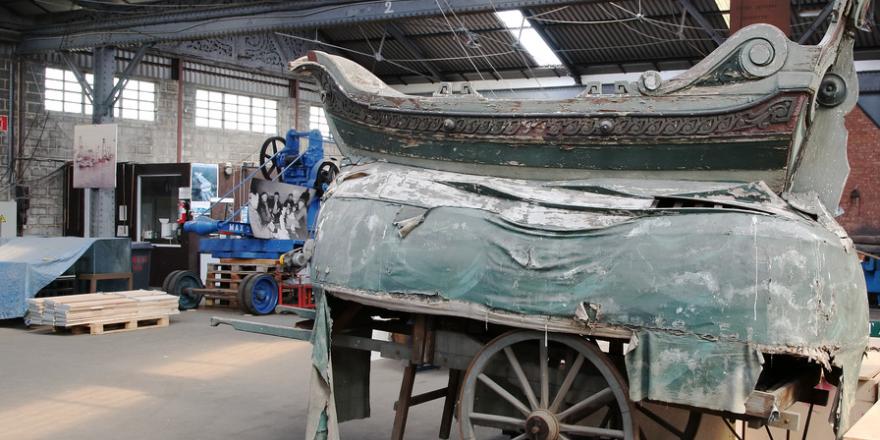
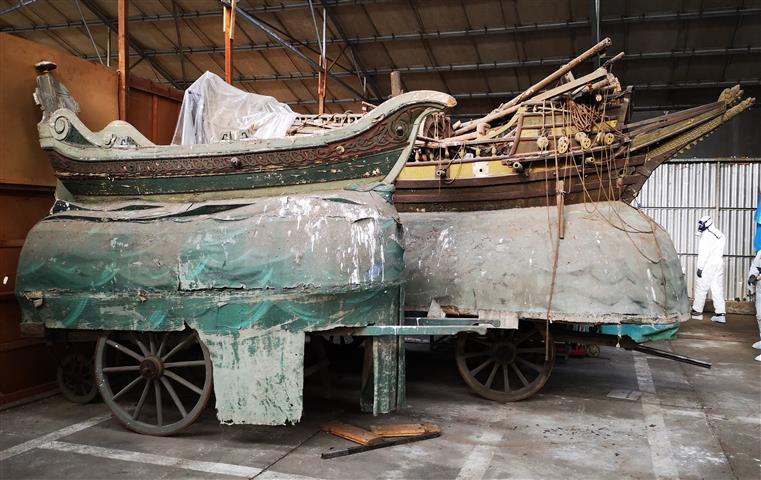
Large ship and barge in the depot with asbestos issues
- © Riet De Coninck, 2019?Recovered floats
In 2009, three floats were recovered from a depot belonging to the Archaeology Department: a float depicting a 17th-century ship and two pushcarts with sloops. They closely resembled the floats depicted in numerous paintings and photographs of the Antwerp processions. As the depot was closing, the three floats had to be relocated. The MAS decided to include them in its collection. From then on, the floats became museum objects (with inventory numbers: MAS.0115.001, 002, 003).
In 2018, the floats had to be moved again due to an asbestos problem in the depot at the time. The Conservation and Management Department of Museums and Heritage Antwerp and the MAS carried out a valuation. The condition of the three floats was poor and without treatment they would increasingly lose their cultural-historical, visual, and social value. Meanwhile, plans for the MAS exhibition Listen were also taking shape. This exhibition provided the ideal opportunity to finally dust off one of the floats and give it a new future. And so began a fascinating conservation process.
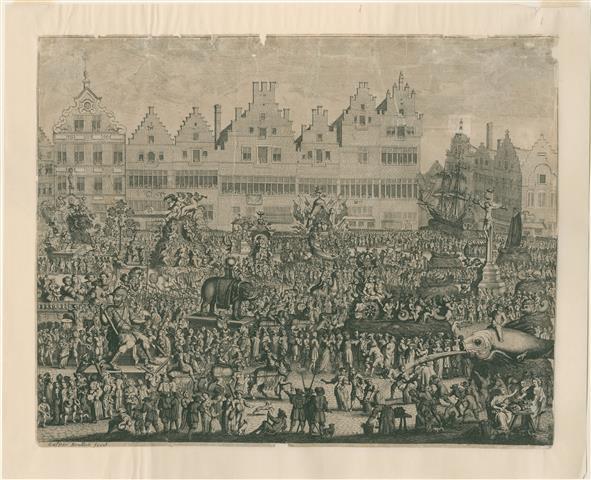
Bouttats, Gaspar (I) (engraver), Verdussen, Hieronymus (publisher), Antwerp procession of 1685. Collection Museum Plantin-Moretus Antwerp, PK.OP.20744.
The tradition of the procession
The ship and the two barges are part of the centuries-old tradition of city parades or processions. The first mention of such processions in Antwerp dates back to 1324. The name ommegang originally means ‘to go (around) [the church or the city]’. They were religious in nature, but from the Middle Ages onwards, secular elements also came into play. Religious holidays and the joyful arrival of a new monarch were occasions for a procession.
The processions were a visual spectacle in which a number of fixed elements appeared from the 15th to the 20th century, in ever-changing scenarios. Representatives of the church and religious orders, the craftsmen's guilds, and the armed guilds as defenders of the city took part. They were followed by the floats, with classics such as the giant Druon Antigoon, the giantess Stadsmaagd, and, from the 17th century onwards, Pallas Athena, the whale, the elephant, and the ship.
In the 19th century, the ommegang tradition gained new momentum when the city underwent rapid modernization and parades about Antwerp's past became popular. The last procession in this form took place in 1958. Other parades, such as the 'Reuzenstoet' (Giants Parade) in Borgerhout, continue to flourish in Antwerp to this day.
The three floats from the MAS collection form an ensemble within the tradition of processions. They usually traveled together, as shown in photographs and drawings of processions from the 19th century onwards. The ship represents the commercial prosperity of the port city, thanks to shipping. The barges support that story. The ship and barges carried children or men wearing traditional costumes from different countries with which trade was conducted. The float with the large ship was pulled by two or four horses and the pushcarts by one to three men.
Origin and age of the floats
Current knowledge about the origin of the three floats in the MAS collection (MAS.0115.001,002, 003) is based on visual sources and the materials used. A stereo photograph of a procession on the Meir in 1860 shows a very similar large ship and, somewhat less clearly, the barges. These are probably the precursors of the current three floats, as the use of industrial bolts in the chassis and plywood in the decoration of the barges suggests that they were manufactured around 1900. Further research is needed to determine whether older parts have been incorporated into the floats and whether the large ship is perhaps older than the chassis and the boats.
The first image depicting the large ship and one barge as we know them today is a drawing in the commemorative book of the Olive Branch Procession from 1875. When the three wagons were discovered in 2009, it was suspected that they had been built for this procession. However, the introduction to the album does not mention the construction of new floats, but rather the use of existing ones.
The first clear photo of the current floats shows them in all their glory during the 1894 World's Fair. The backdrop looks older, but that is because Antwerp had reconstructed an old 17th-century neighborhood for the World's Fair.
Other glass positives from around 1900 in the MAS collection provide a good impression of the two barges and the ship. All these photos clearly show that they were in good condition at the time, perhaps even in their original state. The MAS collection also contains photographs of processions in 1935, 1948, and 1958 that clearly show the large ship. After that, the three floats were no longer used and were slowly forgotten until their rediscovery in 2009.
Living heritage and/or museum object?
The procession tradition is first and foremost a living heritage practice. The tradition revolves around organizing parades with varying scenarios time and time again. The floats were used in different types of processions. Before each procession, they were thoroughly checked and made ready for use. A new coat of paint was applied where necessary, worn parts were replaced, and the axles were well greased.
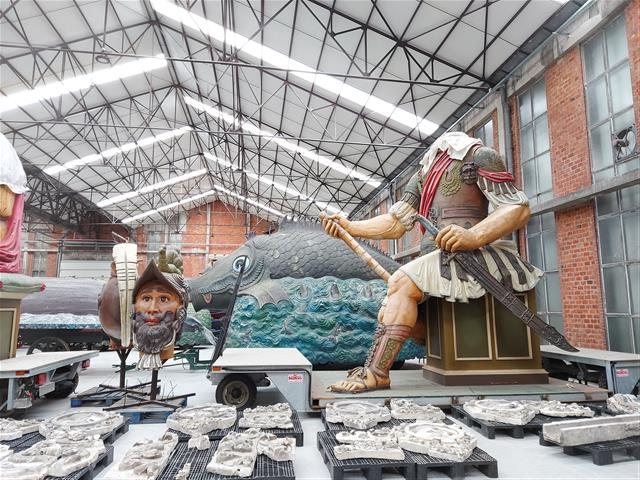
Reconstructions of the classic procession wagons
- © Riet De Coninck, 2021This was also the case for the floats in the MAS collection. For example, we can see that the viewing holes in the pushcarts gradually disappeared under a second layer of fabric. In one of the barges, the viewing hole is still present in the underlying structure; in the other, it has disappeared entirely. These modifications date from after 1920, as evidenced by a photograph showing a barge with a viewing hole while in storage in a hangar. When a float was deemed too worn out, a new one would be constructed—faithful to the previous model but built with the most up‑to‑date techniques of the time.
The three wagons in the MAS collection have undergone very few alterations because they were used only sparingly in the 20th century. They therefore contain more authentic elements than parade wagons that continued to be used for a longer period. For this reason, these floats are particularly valuable for cultural‑historical research.
The heritage of the City of Antwerp still includes other classical parade wagons, such as the whale, the little dolphins, and the giants. All of these wagons were reconstructed over the course of the 20th century.
During the 2019 valuation study, several possible approaches for the three floats were considered:
- The first scenario, which was ultimately carried out, consisted of asbestos remediation and improving storage conditions to prevent further loss of value.
- A second possible scenario involved the full reconstruction of the floats with the goal of using them again in Antwerp processions, thus valuing them primarily as living heritage. At the beginning of the project, the nonprofit organization Reuzenstoet Borgerhout expressed interest in reusing the large ship (MAS.0115.001). They had already done so with two other, more recent wagons. However, reconstruction would alter the original structure and condition of the wagon, reducing its cultural‑historical value.
- A third scenario involved primarily valuing the wagons as cultural‑historical objects that document the past, followed by carrying out a conservation treatment appropriate for museum objects. This means restoring as minimally as possible, preserving as much original material as possible, and ensuring that all interventions are reversible. This option was preferred, as the three wagons have undergone very few changes since the late 19th century and therefore accurately document the history of the Ommegang and historical wagon‑building techniques.
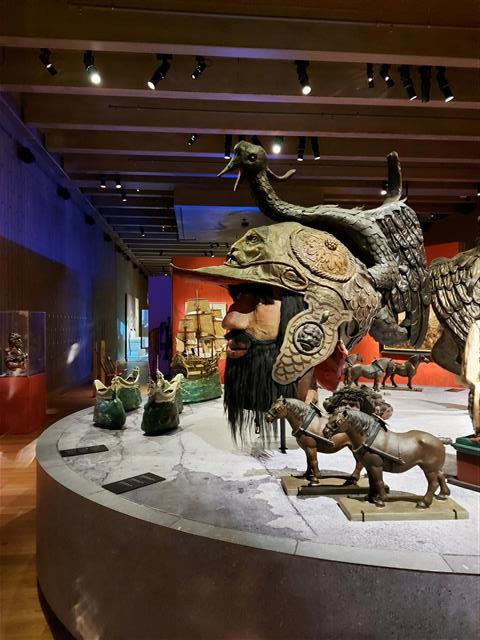
The exhibition 'Celebration' in the MAS with the original giant heads and plaster models of barges and the ship
- © Riet De Coninck, 2021A museum conservation treatment does not allow the wagons to be used outdoors again. The treatment is not designed to withstand weather conditions, and due to the minimal‑intervention approach, the wagon is not truly “ornate” in appearance. Still, the connection to the living heritage tradition remains: the wagons preserved by the museum can serve as inspiration for new floats. This also happened in the past with the giant heads of Druon Antigoon and Pallas Athena. The 16th- and 17th‑century heads are preserved in the MAS collection (VM.2004.1021.001 and ‑002), while replicas are used in processions.
Although a parade wagon cannot move inside a museum, there are other ways to highlight intangible heritage: through paintings, photographs, film, models, and — in the MAS exhibition Celebration—with a rotating platform on which the giant heads of Druon Antigoon and Pallas Athena slowly turn.
Because of their size, a full museum‑level treatment and presentation of the three floats remains a challenge. Every intervention and movement requires a major investment. Finding proper storage and climate‑controlled presentation spaces is equally difficult. We hope to develop creative solutions together with partners who care deeply about Antwerp’s procession heritage. But the first step has been taken: for the MAS exhibition Listen, the barge MAS.0115.003 was restored.
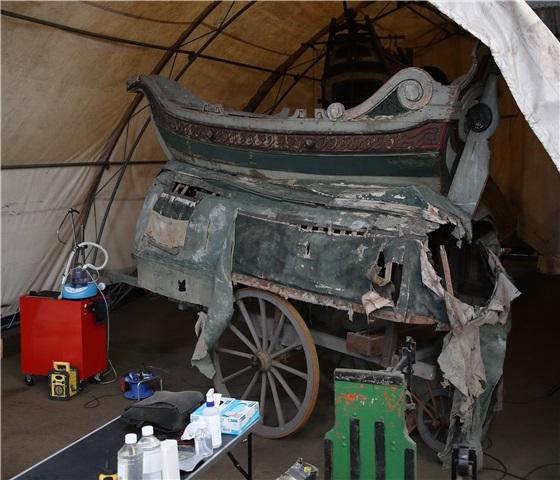
Barge MAS.0115.003 during treatment
- © Bart Huysmans, 2021The treatment of barge MAS.0115.003
For the MAS exhibition Listen, we wanted to display at least one float. The large ship (MAS.0115.001), with its strong visual appeal, was initially the preferred choice. But it could not physically enter the exhibition hall. In addition to size limitations, the condition of the ship ultimately led us to choose one of the barges (MAS.0115.003). Structurally, the barge was in the worst state due to a large hole in the rear. However, it had other advantages: the paint layer on the barge itself was in relatively good condition, and inside it still featured a decorative medallion that was missing in the other barge.
The restoration began in spring 2021 with emergency stabilizations. Where needed, a dry cleaning followed. A damp cleaning was then attempted by external restoration firm Art Salvage, but this proved impossible in some areas. The paint on the outer textile layer had deteriorated so badly that even gel‑based cleaning tests removed too much pigment. Therefore, that layer was only consolidated. Before this step, paint samples were taken from the barge and its three textile skirts; analysis confirmed earlier suspicions that the wagon—and likely both barges—were built around the turn of the 20th century.
After consolidation, the textile was reinforced with a lining. For this, the skirts were removed from the wagon. The lining was color‑matched, and after consultation, we decided to make one side longer than the remaining original textile. This way, the pushcart is once again visually concealed, as it was in the past. The metal parts of the cart were cleaned, corrosion was stabilized, and a transparent finish was applied. The large missing section of the wooden frame at the rear was repaired using steamed wooden slats.
Although the initial plan was a minimal intervention focused mainly on cleaning and stabilization, it was decided during treatment to go a step further to improve the readability of the object as a whole. With the extended skirt and retouching of the wooden elements, the intended visual connection between the barge and the textile was restored. At the end of the restoration, the wagon underwent an anoxia treatment to eliminate any potential insect presence.
Into the exhibition hall
On October 5, 2021, the parade wagon was transported to the MAS and lifted into the exhibition hall on the third floor using a crane through the exterior wall hatch. With a height of 295 cm, a width of 181 cm, and a length of 485 cm, the wagon received a place of honor in the MAS exhibition Listen.