

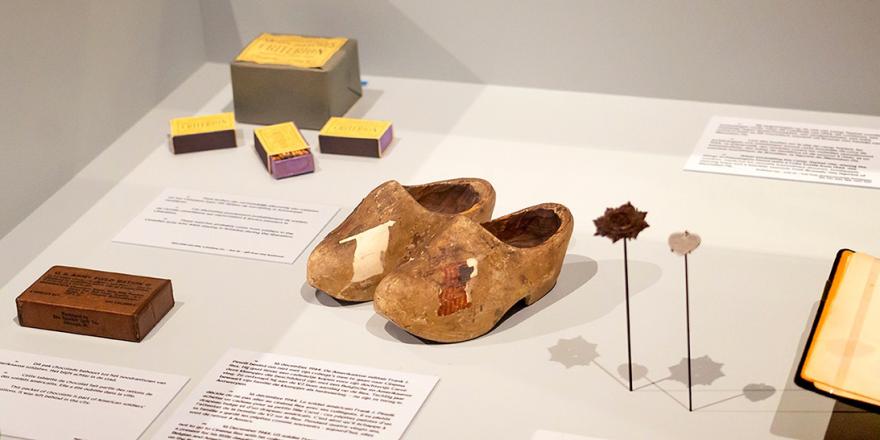
Four V2 bombs in one day
At 11:35 a.m., the first V2 rocket hits Pothoekstraat 15. At 2:45 p.m., a second V2 rocket strikes Minderbroederstraat, again causing fatalities.
Meanwhile, around 900 people seek distraction at Cinema Rex, where the western The Plainsman is showing that afternoon. At 3:23 p.m., they are watching a flashback scene in which the hero Buffalo Bill remembers something. Suddenly, a V2 bomb strikes. The devastation is terrible; never before in history has a single bomb claimed so many victims. Among the 567 dead are 296 Allied soldiers.
At 5:05 p.m., a fourth V2 bomb hits Twee Netenstraat. Another 71 people lose their lives and 84 are injured.
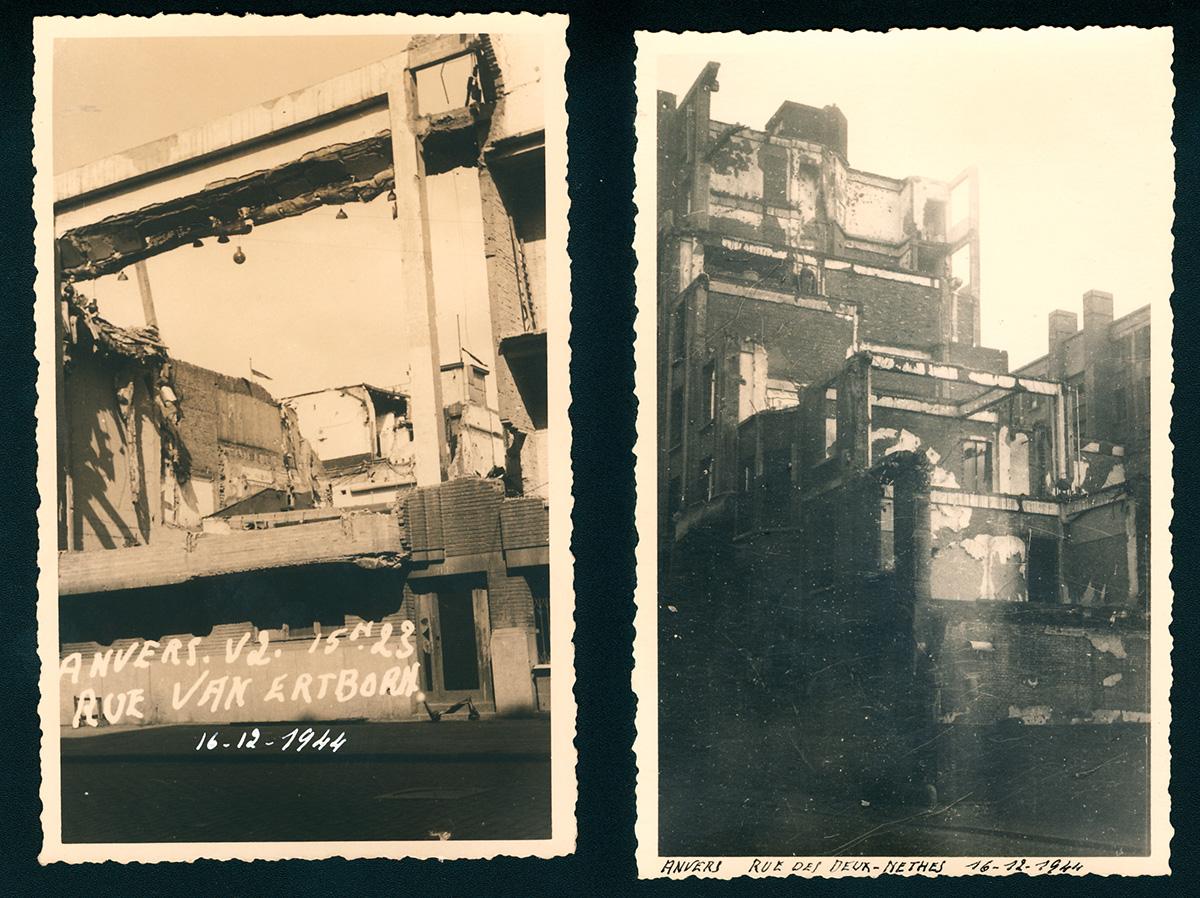
Van Ertbornstraat (Cinema Rex), 16 December 1944 — Twee Netenstraat, 16 December 1944 (photographs by Louis Pighini)
Personal souvenirs
In the City at War exhibition, the large V1 bomb immediately catches the eye. This practice bomb was donated to the city in 1945 by American General Clare H. Armstrong, who led the anti-aircraft defense against the V-bombs.
Smaller souvenirs, some of them very small indeed, lie beneath and around the V1. Each and every one of them is an impressive personal object. They make the emotional impact of the attack tangible. Here we highlight some of these mementos, which people donated or loaned to the MAS for the exhibition.
The flower that Marthe Van Hoof-Merlin wore
The story of this flower in the Belgian tricolor begins on September 4, 1944. On that day, British tanks entered the city from the south. Many citizens greeted them with flags and other symbols in the national tricolor to celebrate the liberation.
Marthe Van Hoof-Merlin, who lives in Belgiëlei, wore this flower as a corsage on September 4 (and probably several times after that). On December 16, her seventeen-year-old son Paul died in the bombing of Cinema Rex. After that, she put the flower away for good. Her grandson brought it out again for the exhibition at the MAS.
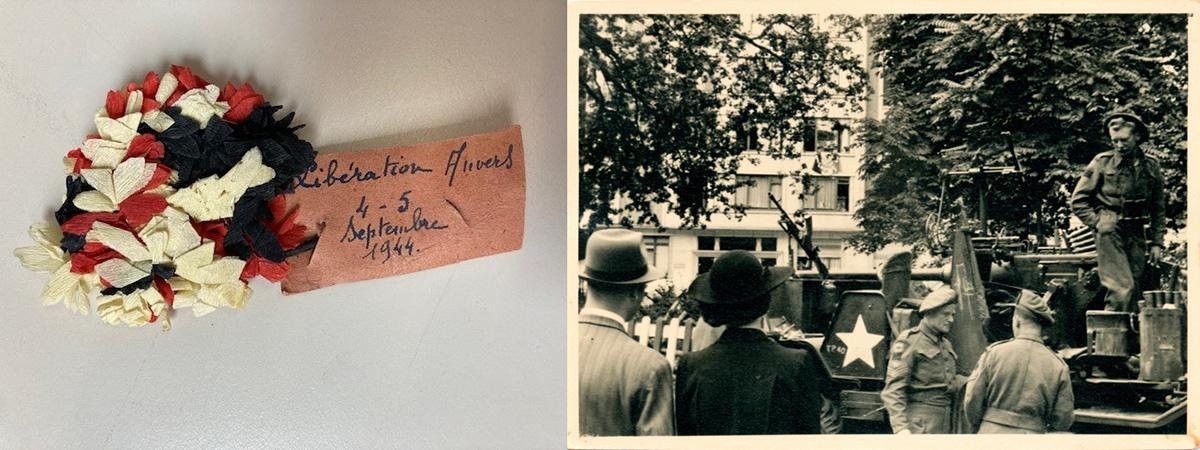
Corsage and photograph of American soldiers in the Belgiëlei shortly after 4 September 1944 (donated by Thierry Van Hissenhoven)
The clogs that saved Frank J. Pinelli
Frank J. Pinelli from Chicago was active in the Normandy landings from June 1944 onwards. From October, he contributed to the defense of Antwerp against V-bombs. He was a supply clerk, responsible for supplying the combat units.
On December 16, 1944, his colleagues asked him to go with them to Cinema Rex. But he chose to buy a present for his daughter Carol: these wooden clogs, painted with the Belgian and American flags. That choice saved his life.
His family kept the clogs as a memento for 80 years. Thanks to the Pinelli family, they have been on display in the exhibition since 2025.
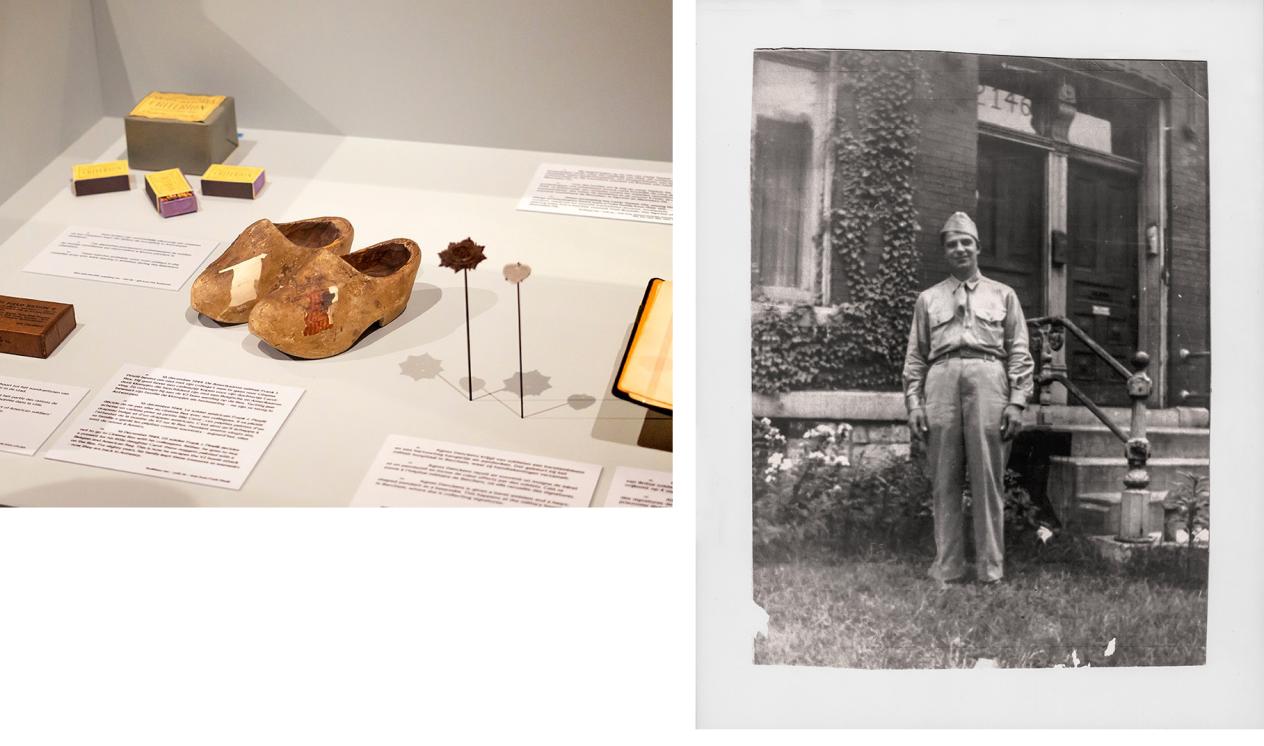
Clogs and photograph of Frank J. Pinelli, 1943–1946 (on loan from Frank Pinelli)
Lucky Straatman's movie ticket
‘Antwerp’s Prachtkinema' ('Antwerp's Magnificent Cinema’). That is what is written on the back of the cinema ticket that Lucky Straatman bought at Cinema Rex on December 16, 1944. That slogan sounds particularly ironic when we think of the high toll of the V2 attack: 567 dead and 291 wounded.
Lucky was born in 1929 into a French-speaking Antwerp family who lived on Kolonielaan (now Camille Huysmanslaan) in 1944. He was a student at the Lycée d'Anvers and a member of scout troop no. 131 Les Antilopes.
When liberation came in September 1944, the future looked bright for this fifteen-year-old boy. This is also evident from the photo of Lucky on the Keyserlei, shortly after liberation on September 4, 1944. The family remembers that Lucky's mother initially did not want to let him go to the movies because of the risk of V-bombs. The trip to the cinema ended tragically. When Lucky's body was identified, the ticket for the ‘Prachtkinema’ was found in his pocket.
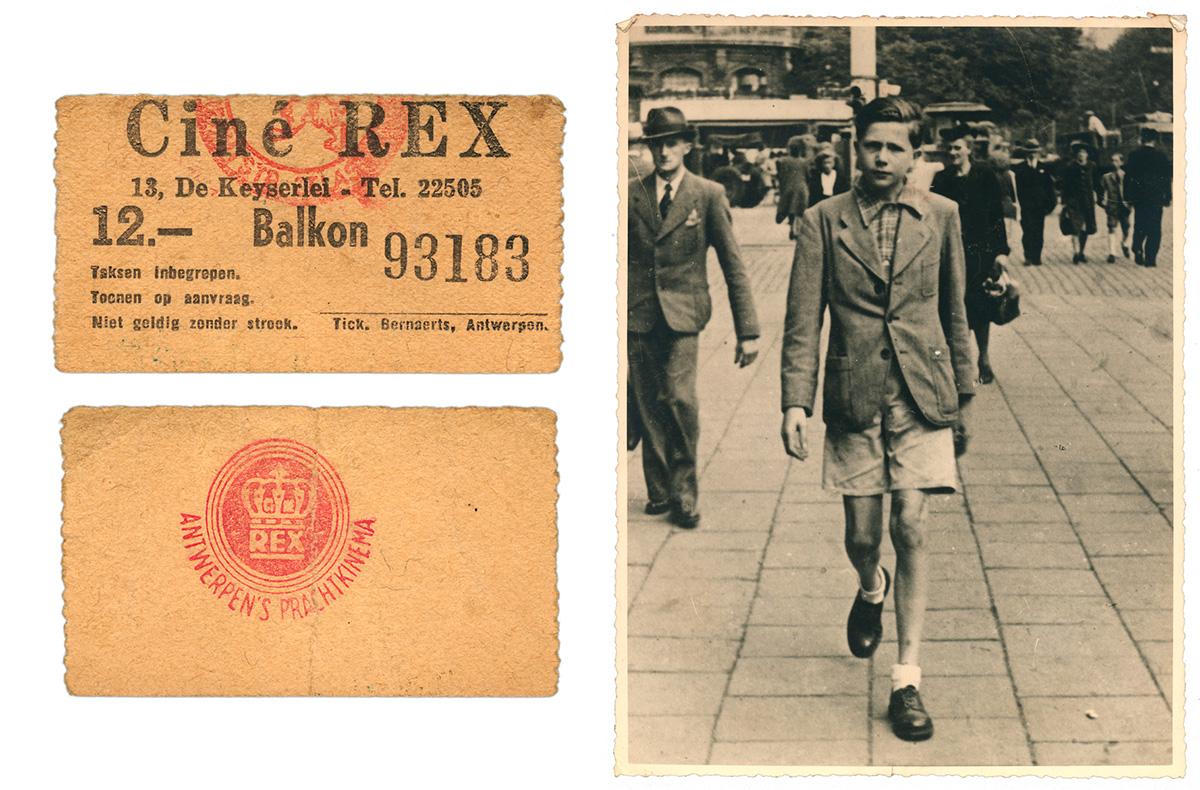
Cinema Rex admission ticket dated 16 December 1944 and photograph of Lucky on Keyserlei, presumably September 1944 (donated by Gerald Straatman)
The memorial card of Irma and Maria, with their communion photo
On Thursday, December 14, 1944, a V2 bomb fell on Twee Netenstraat, right next to the Dobbeleers family's apartment. Six people were killed, but the Dobbeleers family suffered only material damage. They were clearing away the rubble when, at 5:05 p.m. on December 16, a second V2 bomb struck the apartment building.
At that fatal moment, sisters Irma and Maria Dobbeleers, aged 11 and 12, were getting soup from a food distribution point across the street. They were killed by falling concrete blocks. It was not until several days later that they were found under the rubble.
The death notice shows the communion photo of the two sisters taken just a few months earlier. This was common practice for young victims. The cause of death is vaguely described as “accident due to war conditions.” This is probably because the Allies asked the civilian population to remain silent about the bombings. This would prevent the German army from assessing how effective they were.
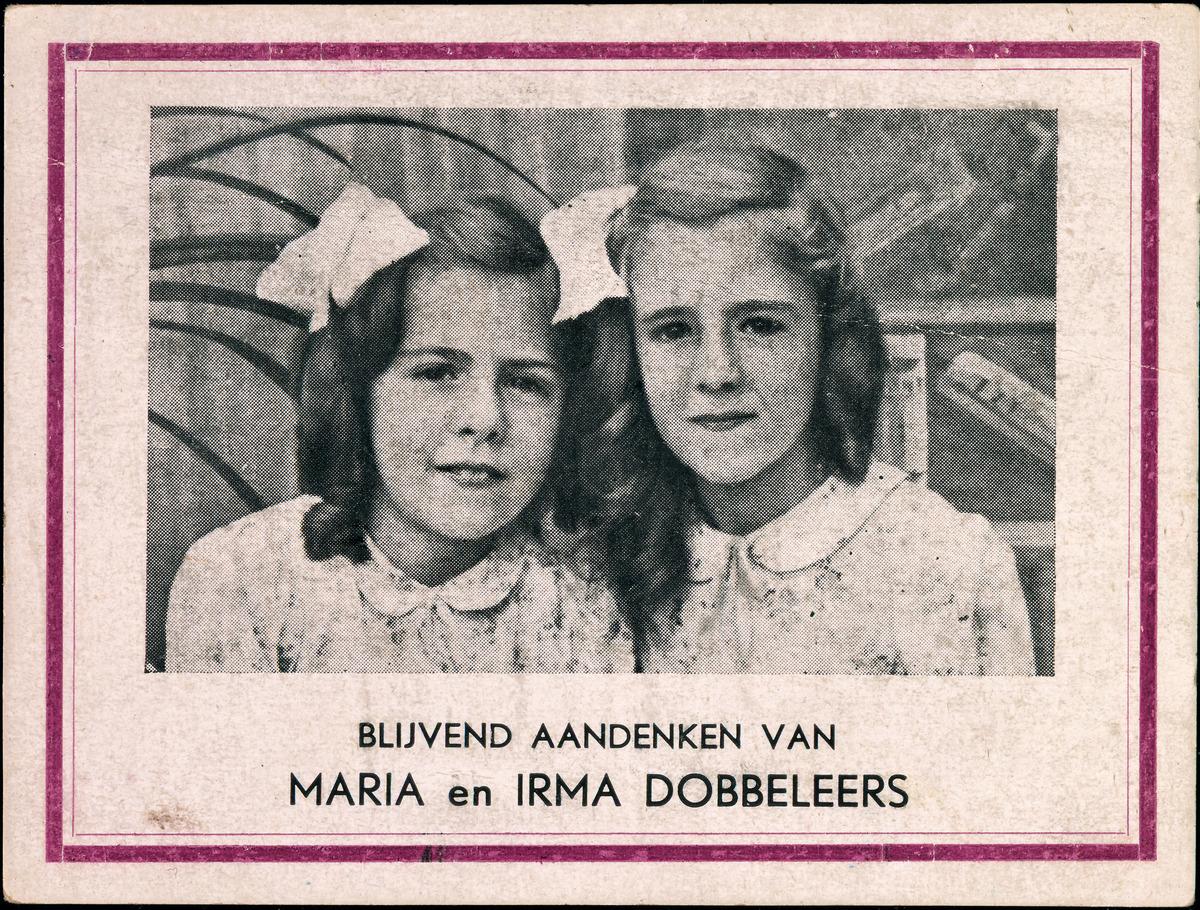
Death notice of Irma and Maria Dobbeleers, 1944 (donated by Martha Dobbeleers)
Name tag and bag belonging to evacuated preschooler Roger Deridder
After the attack on Cinema Rex, gatherings of more than fifty people are banned. Schools, theaters, and cinemas close. From then on, shelters are also used during the day. More and more city residents flee or are evacuated. An estimated 106,000 people, about one-fifth of Antwerp's population, leave.
The Deridder family from Deurne decided to take their children to safety. Their daughter Josée was able to stay with family in Leuven. Their sons André and Roger left via the organized evacuation, but did not stay together. A foster family was found for André in Izegem in West Flanders, and for Roger with the Laurent farming family in Bertem in Flemish Brabant.
Roger leaves with this bag, to which his name tag is attached, so that the foster family can send a letter to his parents, who do not know where he is going. After the war, the foster parents visit Roger at his home in Deurne and he gets the bag with the name tag back.
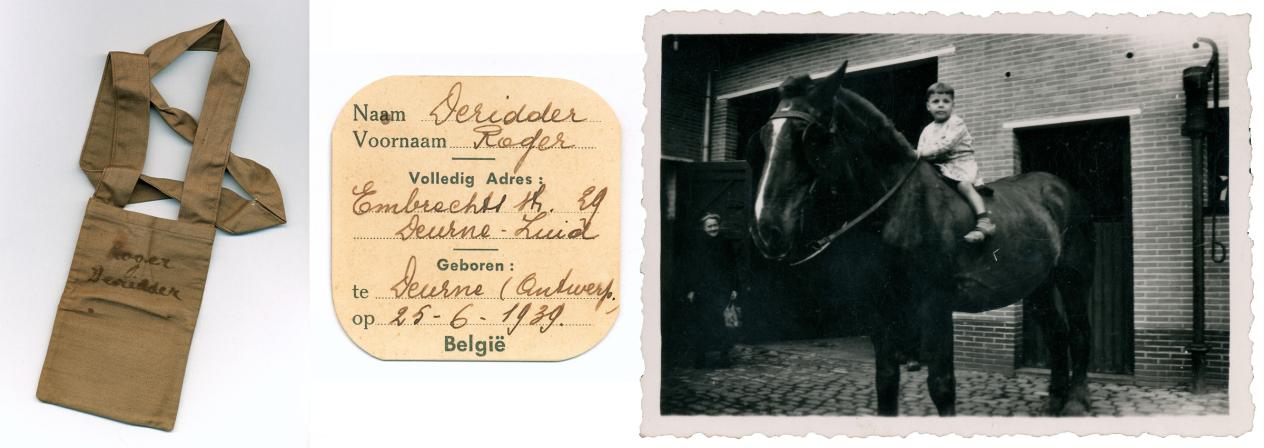
Bag, name tag and photograph of five-year-old Roger in Bertem, 1944–1945 (donated by Roger Deridder)
