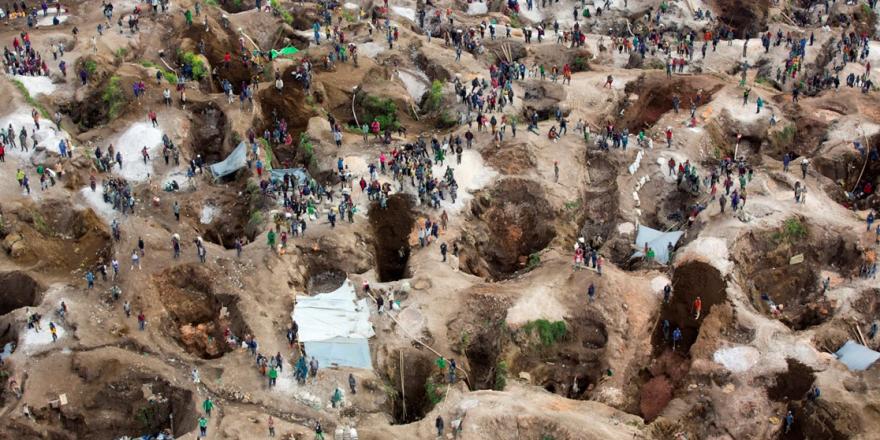
Based on years of research in Congo, Smith explores the everyday lives and working conditions of Congolese miners. He discusses the challenges they face and how they themselves understand issues such as the global trade in natural resources, regulations surrounding “conflict-free” minerals and the recurring outbreaks of violence.
Smith examines who mines coltan and other minerals, often in former colonial mining areas, and how these resources eventually make their way onto the international market.
Practical information
- When: Saturday 7 November
- Where: MAS Box, Hanzestedenplaats, 2000 Antwerp
- Language: English
- Admission: free, registration required
Program
14h: welcome
14.10h: lecture by Prof. James H. Smith, author of the award-winning book
14.45h: panel discussion with Drs. Divin-Luc Bikubanya
15.15h: free visit to the exhibition 'Vracht' (6th floor, MAS)
Speakers
James H. Smith is Professor of Anthropology at the University of California, Davis, USA. He is known for his extensive research on conflict minerals and artisanal mining in eastern Congo. His critical insights and close attention to the perspectives and working conditions of Congolese miners are reflected in The Eyes of the World, which has received several awards and honours, including the prestigious Elliot P. Skinner Book Prize for African Anthropology.
Drs. Divin-Luc Bikubanya is a PhD researcher and teaching assistant at the Institute of Development Policy (IOB) at the University of Antwerp. His research focuses on global and regional value chains in the mining sector (gold, coltan and cassiterite) and the construction sector (cement) in eastern Congo.
This event is organised by Els De Palmenaer, curator of Africa at MAS, in collaboration with Dr Katrien Pype, cultural anthropologist and Associate Professor at KU Leuven.
Abstract
The Eyes of the World: Mining the Digital Age in the Eastern Congo, James H. Smith (University of California, Davis)
Based on long-term ethnographic research on artisanal mining and conflict minerals in eastern Congo, the Eyes of the World examines the working lives and theories of various types of Congolese workers in the supply chain for Congolese “digital minerals”. The book closely engages their experiences of and insights into global capitalism, international “conflict free” regulatory efforts, on-going wars, and other historical forces that have acted on them. Among other things, the Eyes of the World shows that Congolese miners often experience transparency-focused conflict minerals certification systems as violent efforts at enclosure and exclusion that threaten conditions they referred to as “movement” and “many hands touching money”. They understood bar coded traceability tags as “handcuffs” (craca) that immobilized and made them vulnerable to various forms of abuse and expropriation, and instead emphasized their work as a form of sacrifice, collaborative social production, and peace-building.